
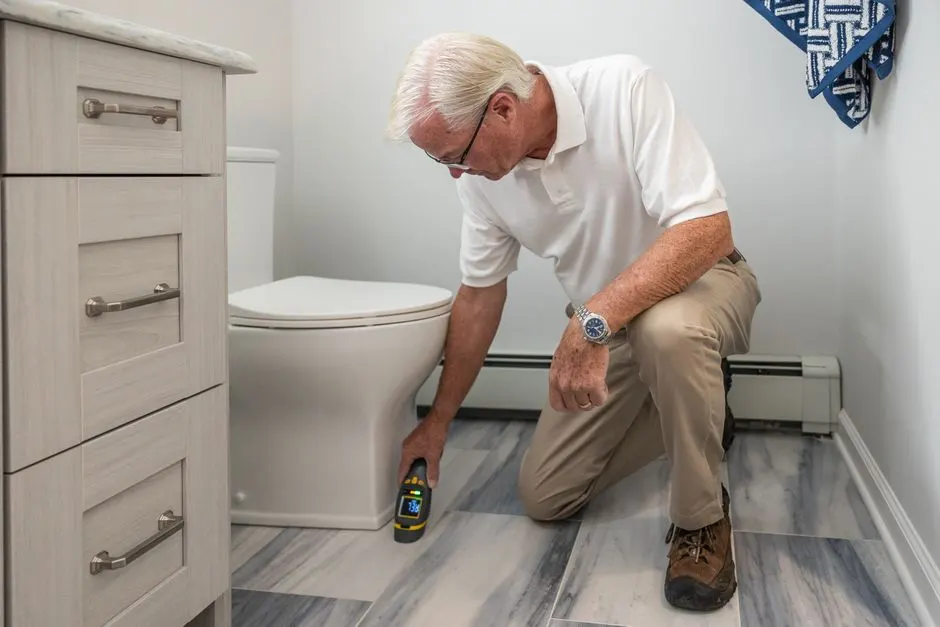
You have a slab leak if you notice warm spots on the floor, the sound of running water when every fixture is off, or a water bill that jumped by $50 to $150 in a single month with no change in usage. Those three signs together point to a broken pipe under your concrete foundation. This post walks through every symptom we see in Covina, how to confirm the leak yourself in about 15 minutes, and what to do next before the water damages your flooring or foundation.
What a slab leak actually is
A slab leak is a plumbing leak in the water or drain lines that run beneath your home's concrete foundation slab. In Covina, most homes built between 1955 and 1985 have copper supply lines buried directly in or under the slab, and those lines corrode from the outside in after 30 to 50 years.
When a copper line fails under the slab, water doesn't disappear. It soaks into the soil, wicks up through the concrete, and eventually finds its way to the surface - or into your flooring. A pinhole leak the size of a pencil tip can waste 10,000 to 30,000 gallons of water a month. That's roughly the volume of a backyard swimming pool, quietly draining under your living room.
Slab leaks are one of the most misdiagnosed problems in residential plumbing. Homeowners often blame the water heater, the irrigation system, or a running toilet for weeks before anyone thinks to look under the floor.
The 7 signs of a slab leak in Covina, California homes
Here are the slab leak symptoms in Covina, California that we look for first when a homeowner calls us with a high water bill and no visible leak.
1. Warm or hot spots on the floor
If you have a hot water line leak under the slab, the escaping hot water heats the concrete above it. Walk barefoot across your tile or vinyl in the morning. A patch of floor that's noticeably warmer than the surrounding area - often 5 to 15 degrees warmer - is the single most reliable sign of a hot-side slab leak.
2. The sound of running water when everything is off
At night, when the house is quiet, put your ear near the floor. If you hear a steady hiss or the sound of water moving through a pipe, and every faucet, toilet, and appliance is off, that's a leak. A stethoscope or even a glass pressed against the floor makes it easier to hear.
3. A water bill that jumped without explanation
Covina water rates run roughly $4 to $6 per hundred cubic feet (CCF). If your normal bill is $70 and it suddenly reads $180, you're losing water somewhere. Check the meter before you call anyone: shut off every fixture in the house, then watch the low-flow indicator on your meter. If it's still spinning, you have a leak - and if no toilet or faucet is running, it's under the slab.
4. Cracks in the floor or foundation
Water under a slab doesn't just sit there. It erodes the soil, creates voids, and causes the concrete to shift. Look for new cracks in tile grout, hairline cracks running across the floor, or doors that suddenly stick. A slab leak left for six months can cause $8,000 to $25,000 in foundation damage.
5. Damp carpet or buckled flooring
If a patch of carpet feels damp, smells musty, or the laminate or vinyl is starting to cup at the seams, water is coming up from below. This is more common in Covina homes with original 1960s slab construction, where there's no moisture barrier between the concrete and the flooring.
6. Mold or mildew along the baseboards
Mold needs moisture and 24 to 48 hours to start growing. If you see dark staining or smell that earthy mildew odor along the bottom of a wall - especially an interior wall - the moisture is likely coming from below, not from a roof leak.
7. A water heater that runs constantly
When a hot water slab leak is present, your water heater never gets a break. It reheats the same water over and over. If your gas bill is climbing alongside your water bill, and the water heater is running more than usual, that's a strong secondary indicator.
How do I know if I have a slab leak under my floor in Covina CA?
You can confirm a slab leak in about 15 minutes with a two-step test using your water meter and your ears. Here's the process we walk homeowners through on the phone before we ever send a truck.
- Shut off every water-using fixture in the house. That means faucets, toilets, the ice maker, the washing machine, the dishwasher, and any irrigation. Wait 10 minutes.
- Find your water meter - usually in a concrete box near the sidewalk. Lift the lid and look at the low-flow indicator (a small triangle or gear). If it's moving, water is passing through the meter.
- Shut off the main valve at the house. If the meter stops spinning when the house valve is closed, the leak is inside your plumbing - possibly under the slab. If it keeps spinning, the leak is between the meter and the house.
- Listen at the floor. With the house valve back on and everything else off, press a glass or stethoscope to the floor and move it slowly. The loudest point is usually within 2 to 3 feet of the leak.
If those steps point to a leak under the slab, the next move is professional leak detection Covina CA. We use acoustic listening equipment, thermal imaging, and electronic line tracing to pinpoint the break within inches - no exploratory jackhammering.
Why slab leaks are common in Covina and the San Gabriel Valley
Covina sits on some of the hardest water in Southern California, and that water is the main reason slab leaks are so common here. Our water comes from a mix of groundwater and imported Metropolitan Water District supply, and it carries high levels of calcium and magnesium - typically 10 to 16 grains per gallon of hardness.
Hard water doesn't just scale up your showerhead. Inside a copper pipe, minerals deposit on the walls and create turbulence. Over 40 to 60 years, that turbulence erodes the pipe from the inside. Combine that with the soil movement we get during dry summers and wet winters, and you have the two conditions that kill buried copper lines.
The housing stock matters too. Most of the homes in plumbing in Downtown Covina and the surrounding neighborhoods were built in the postwar boom, when copper was the standard and nobody expected the lines to last 70 years. They didn't. We see the same pattern in neighboring plumbing in Charter Oak, where mid-century tracts share the same construction era and the same hard water supply.
If your home was built before 1985 and still has original copper under the slab, you're in the window where slab leaks become likely, not just possible.
What to do if you suspect a slab leak in Covina CA
If you suspect a slab leak in Covina CA, shut off the main water valve to the house and call a licensed plumber the same day. Every hour the leak runs costs you water, gas, and potential foundation damage. Here's the order of operations we recommend:
- Shut off the main valve. This stops the water from feeding the leak and limits damage. You'll be without water until the repair, but that's better than a flooded floor.
- Document everything. Take photos of the water bill, the meter reading, any damp spots, and any cracks. If you file an insurance claim, this evidence matters.
- Call for detection, not just repair. A plumber who shows up with a jackhammer and starts guessing is going to cost you more than one who shows up with listening equipment. Ask specifically for electronic leak detection.
- Get a repair plan with options. There are three main ways to fix a slab leak: spot repair (jackhammer to the break and patch the pipe), reroute (run a new line overhead through the attic or walls), or whole-home repiping. Each has a different cost and lifespan.
Typical 2026 pricing in Covina for slab leak repair runs $1,500 to $4,500 for a spot repair, $3,500 to $7,500 for a reroute, and $8,000 to $15,000 for a full repipe. Detection alone is usually $250 to $500 and often credited toward the repair. If you want to understand the repair side in detail, our slab leak repair Covina CA page breaks down each option.
Common mistakes homeowners make with slab leaks
The most expensive slab leak mistakes we see are delays, wrong diagnoses, and repairs that don't address the cause. Watch for these:
- Waiting for the leak to "fix itself." It won't. Copper doesn't heal. A pinhole becomes a pinhole cluster, and a pinhole cluster becomes a burst line. We've seen a $1,800 spot repair turn into a $12,000 repipe because the homeowner waited six months.
- Blaming the water heater first. A leaking water heater leaves water at the tank, not across the floor. If the moisture is 10 feet from the heater, it's not the heater.
- Hiring a handyman to break concrete. Slab work requires a licensed plumber, a concrete cutter, and a proper pressure test afterward. Unpermitted slab work can complicate a future home sale.
- Repairing the pipe without addressing the water. If your water is 14 grains hard, the new copper will fail the same way the old copper did. A water softener installation Covina adds years to every pipe in the house.
- Ignoring the drain side. Not every slab leak is on a supply line. Cast iron drain lines under 1950s slabs crack and root-intrude too. If you smell sewer gas or see slow drains alongside the moisture, the problem may be a drain, and sewer line repair Covina CA is the right call.
When to call a professional
Call a professional the moment you have two or more of the signs above, or any single sign that's been present for more than a week. Slab leaks don't stabilize - they accelerate. The soil under your foundation gets softer, the void gets bigger, and the repair gets more expensive.
At A1 Plumbing Covina CA, we handle slab leak detection and repair across Covina and the surrounding San Gabriel Valley. We locate the leak with electronic equipment before we cut anything, give you a flat price for the repair, and pressure-test the line before we close up the floor. If a reroute or repipe makes more sense than a spot repair, we'll tell you - and we'll show you why.
For leaks that are actively flooding or have shut down your water, our emergency plumber Covina CA line is staffed around the clock.
Frequently Asked Questions
How do I know if I have a slab leak under my floor in Covina CA?
Check your water meter with every fixture off. If the low-flow indicator is still spinning, you have a leak. Combine that with warm floor spots, the sound of running water, or a water bill that jumped $50 or more, and it's almost certainly under the slab. Professional leak detection confirms it within inches.
What are the signs of a slab leak in Covina, California?
The top signs are warm spots on the floor, unexplained high water bills, the sound of running water when everything is off, new cracks in tile or foundation, damp carpet, mildew along baseboards, and a water heater that runs constantly. Two or more of these together is a strong indicator.
Who do I call for slab leak detection in Covina?
Call a licensed plumbing contractor that specializes in leak detection - not a general handyman. A1 Plumbing Covina CA uses acoustic listening, thermal imaging, and electronic line tracing to pinpoint the leak. Detection typically runs $250 to $500 and is often credited toward the repair.
Can a slab leak fix itself in Covina CA?
No. Copper and cast iron pipes do not self-seal. Mineral deposits can temporarily slow a pinhole leak, but the pipe continues to corrode and the leak returns - usually larger. Waiting typically turns a $1,500 to $4,500 spot repair into a $8,000 to $15,000 repipe.
How much does slab leak repair cost in Covina California?
In 2026, typical Covina pricing is $1,500 to $4,500 for a spot repair, $3,500 to $7,500 for a reroute, and $8,000 to $15,000 for a whole-home repipe. The right option depends on the pipe's age, the number of prior repairs, and how accessible the leak is.
Get help with plumbing in Covina
If your floor is warm, your meter is spinning, or your water bill doubled, don't wait for the damage to spread. We'll find the leak, fix it, and pressure-test the line before we leave.
Call A1 Plumbing Covina CA at 626 687 0334 for same-day slab leak detection and repair across Covina and the San Gabriel Valley.